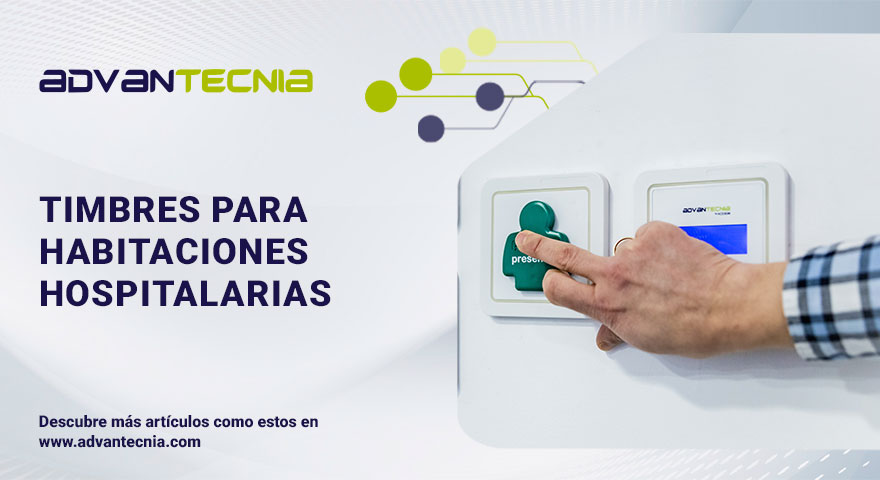
Within the group of devices used to provide a good Patient–Nurse Call service, hospital room call buttons make up the group of devices that offers the greatest variety to choose from. Consequently, when the operation of a hospital or a nursing home is renewed or optimized, questions may arise about which one to choose or why so many models exist.
Hospital Engineering has as its main objective the optimization of hospital communication, in this case related to patient care and monitoring. Therefore, there are so many models because each one is suitable for a specific type of facility and a particular healthcare staff structure.
We are going to explain what hospital room call buttons are, the most commonly used models, and how they work, in order to help you make the right choice. If this article is not enough, do not hesitate to contact us.

Contenidos
What are hospital room call buttons?
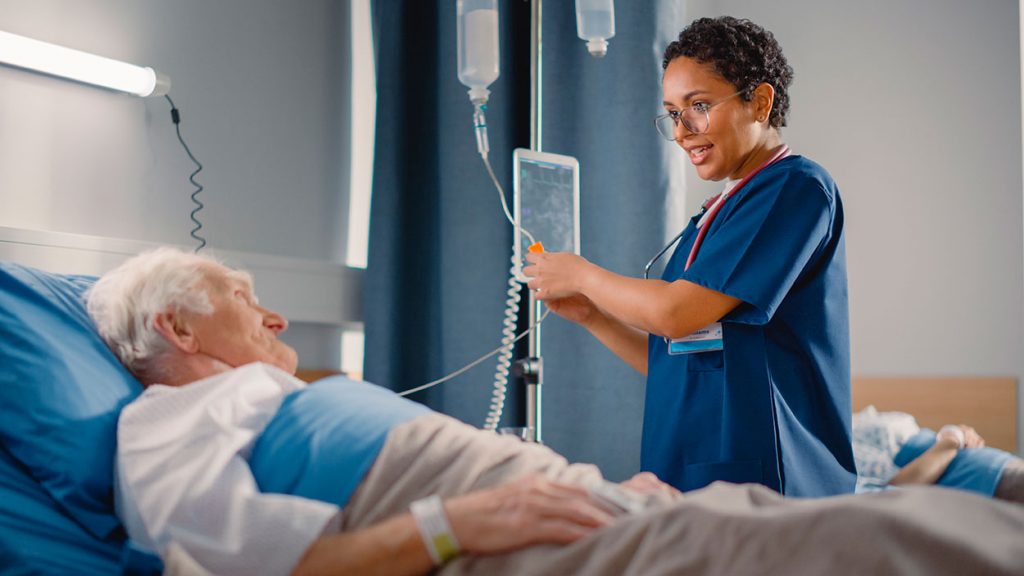
Hospital room call buttons allow patients to communicate any emergency or need to the healthcare staff responsible for that room and other rooms.
We must take into account how limited, in many cases, the number of professionals assigned to this task is, and the fact that multiple incidents may occur at random, making an unexpected, temporary reinforcement necessary. What cannot be expected is for someone to accompany the nurse day and night, because the patient may not have anyone to perform this task and because someone outside the healthcare sector could overlook important signals or become alarmed by routine situations.
It should be clarified that the name call buttons for these patient–nurse call devices comes from their origins, when a mechanical press produced an alert sound. Nowadays, in addition to sound and sending a signal to a screen or a smartphone, hospital room call buttons are usually accompanied by a colored light system to create a new type of alert for each situation: emergencies such as falls or choking, the need for assistance to go to the bathroom, or situations where the patient is experiencing the effects of analgesia are just a few examples.
It is now possible to know whether a nurse is required or if there is an emergency that requires a doctor immediately simply by changing the colors of the lights, without disturbing the rest of the patients in other rooms.
How do they work?
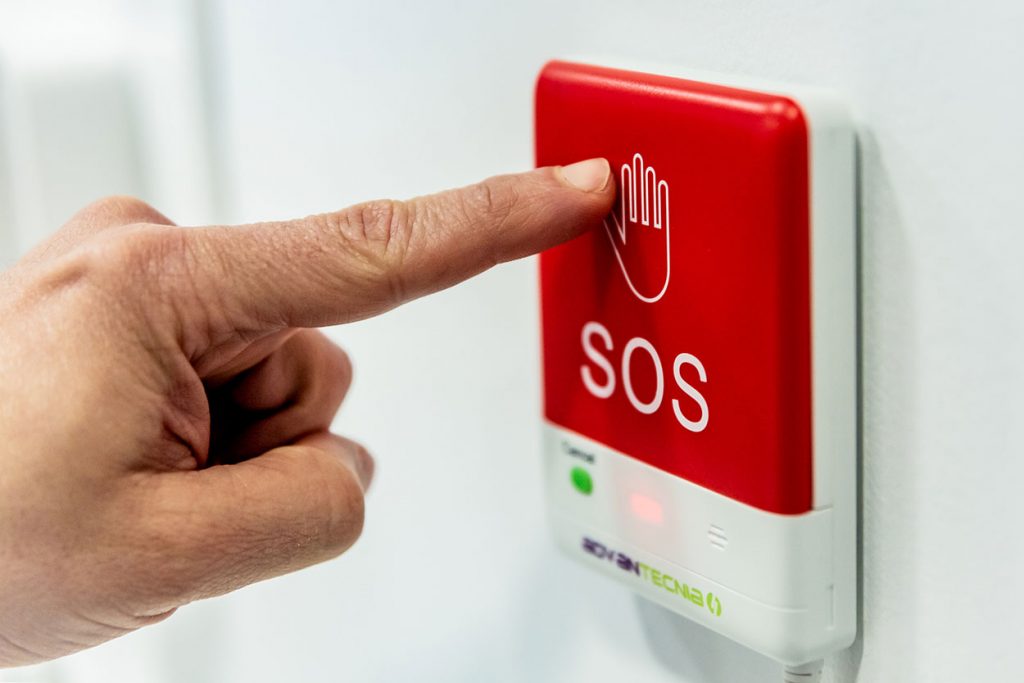
One of the most common call button models still uses the push-button mechanism, either to make an audible call to a nurse or an emergency doctor, or through a system that turns on corridor lights according to the previously mentioned color code.
The so-called presence and cancellation mechanism can also be used, where the patient can manage the color code themselves with one or two button presses.
Let us remember that patient–nurse calls must be available to all patients, not only to those who are able to activate a mechanism. Usability has led many devices to incorporate Braille signals and, as it could not be otherwise, to offer the possibility of activating calls in other ways, generally by voice.
In some cases, especially when working with elderly people, a device that emits a signal when contact is lost is often the best alert for falls and wandering patients, who are frequently disoriented.
Another option for detecting lost patients is to use photoelectric sensors or infrared detectors that transmit a radio signal when a barrier is crossed, such as the entrance to an area reserved for clinic staff.
Lastly, remember that many of these ways of contacting caregivers can already be carried out with wireless devices, with pros and cons, depending more on the design of each hospital than on the type of patients.
Let us now pay attention to the software, that is, the medium and the way in which the staff responsible for patient care receives call alerts and whether they can communicate or not from the point where the signal is received.
The software for hospital room call buttons is in continuous development, which is why it is now common to be able to choose between more than one contact method. For example, with the same device we can ensure that alerts appear on corridor lights, on one or more smartphones of the healthcare staff, and on a PC or web. This last option can save valuable seconds when a blue code occurs, that is, an emergency that requires the immediate presence of a doctor, usually a specialist.
Advances in software also make it possible to choose between different interfaces or ways of communicating. In some cases, displaying symbols may be of interest, while in others, bar-style displays similar to spreadsheets offer better visual control of the status of the rooms to be monitored. Work is always carried out with a notification from the room and a visualization on the side of the staff responsible for care and surveillance.
Benefits of having a call button system for hospital rooms
-
Optimised communication and reduced response times.
-
Possibility of integration with other devices, for example, with a computer where issues related to the clinic or patients are also recorded.
-
System scalability. It does not matter if the hospital expands or ends up having more patients; to adapt it, it will be enough to add a few hospital room call buttons, since the installation and software are prepared in advance.
-
Installation with medical devices, allowing clinical data of the patient to be consulted at the moment a diagnostic test is carried out or when an alarm is triggered. For example, knowing instantly that the patient who reports drowning is asthmatic.
If you still have any questions about which hospital room call button models best suit your clinic or care facility, you can get in contact with Advantecnia. We will offer you the best advice for your organisation and help you choose, taking into account your preferences as well as the guidelines of Hospital Engineering.