Many of us remember doctors using an appointment book to note down our next visit or filling out a prescription by hand that no one could understand—something that, fortunately, is now a thing of the past thanks to healthcare software.
Digitalization has reached medical clinics, so management tasks are now much simpler for doctors, who rely on new technologies in order to provide better service to their patients.
Contenidos
Appointment management systems
Starting with the most basic healthcare software, appointment books can be done away with thanks to programs that manage appointments, which is the first step in the digitalization of many clinics.
Here, available time slots are assigned to patients within a previously configured schedule, and notifications about upcoming appointments can be sent through different channels such as SMS, email, or instant messaging.
In more advanced healthcare software—such as those used by public health systems—patients themselves can choose which day and time they want their appointment.
Waiting queue management
Waiting queuesystems have changed over time. Not long ago, the doctor or a nurse would call patients out loud or through a microphone, but that can no longer be done.
Due to data protection laws, it is necessary to use a system in which a number is assigned to the patient and displayed on a screen when it is their turn to enter the consultation room, along with the room number.
For the queue management system to work, when the patient arrives they go to a machine where they scan a barcode or QR code. This allows the system to check the appointment management system to verify whether it is the correct day.
If it is, the patient is placed in the waiting queue, and as time passes their number appears on a large screen, notifying them that the healthcare professional is ready to see them.
Secure data in the cloud
Any doctor handles an enormous amount of patient data. This is the most sensitive information about a person and must always be especially well protected.
Medical management software helps greatly with this, since clinics do not actually store anything locally; instead, everything is handled by the software itself in the cloud, where data integrity is guaranteed and breaches are prevented.
This eliminates many headaches for clinics, as investments in hardware and security are avoided, while ensuring that patient data is secure and protected from prying eyes.

Help with managing payments from patients and insurers
In private healthcare, patients have to deal with invoices, and delays in payments can occur, so software programs manage these issues automatically.
Thanks to them, clinic staff do not need to review patient payments manually; if a payment is delayed, the software itself sends reminders so the patient can settle it as soon as possible.
They also help with integration with insurance companies, since it is very common for patients at these clinics to have health plans, meaning the insurer will pay for consultations, tests, or part of them.
They enable video consultations
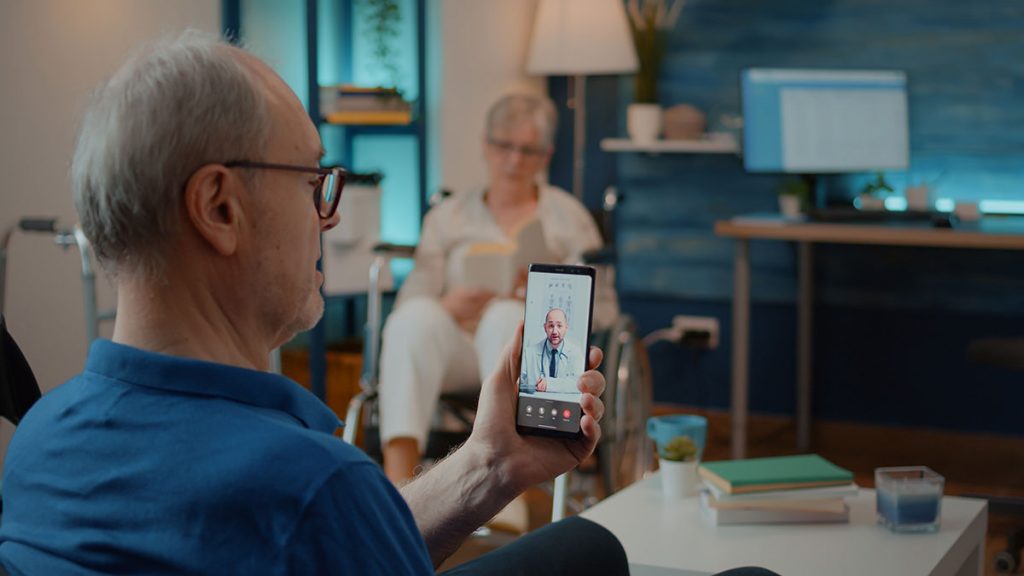
Video consultations were already being used before COVID, but as a result of the pandemic they became essential, and many doctors now use them.
In fact, there are conditions that can be treated this way without the patient needing to travel. In addition, this type of software enables data management, so all data generated during the consultation is stored in the same place.
Of course, privacy and security are guaranteed, but the key point here is that these consultations are recorded and fully integrated into the patient’s medical record.
Patient data can be accessed
Perhaps the most important part of this software is what is usually called an EMR, which is the system that stores the patient’s medical history. In this case, it is hosted in the cloud and can be accessed by anyone with authorization, such as doctors or nurses.
Good EMR systems allow access for both private practitioners and public healthcare professionals, since a patient may use both. In both cases, they must have access to the complete medical history in order to make the best decisions about the patient’s health.
They eliminate errors in medication prescribing
Thanks to the existence of prescription systems, errors have been eliminated—errors that were not uncommon when pharmacists could not understand what doctors had written on prescriptions.
Now, both parties are connected and can know which medications have been prescribed, when the patient has picked them up, whether it is possible to substitute them for another if there is no stock, and it is ensured that the dosage is appropriate.
Dosage and the period during which the patient takes their medication are very important, both to support recovery and to prevent addictions that some medicines can cause.
Since healthcare software was introduced into clinics, the way doctors work has changed, and it is now much more agile and secure. Contact us if you need any of these solutions for your clinic, and you will take your relationship with your patients to the next level.