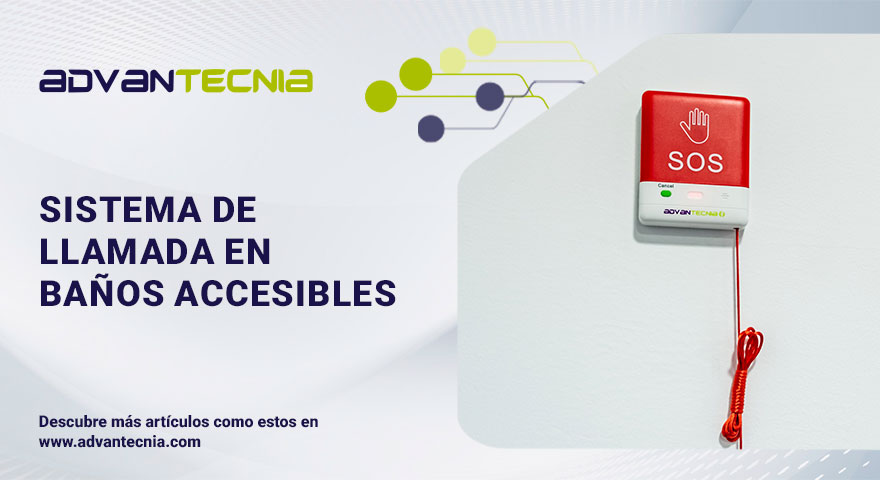
Safety in the use of accessible restrooms largely depends on them being equipped with an accessible bathroom call system whose features comply with the requirements set out in current regulations.
Let us review the requirements that an alert system in accessible bathrooms must meet according to regulations, as well as the advantages of the solutions proposed by Advantecnia.
Contenidos
Required characteristics of an accessible bathroom call system
To simplify, we will avoid making express reference to all the specific articles of the regulations, limiting ourselves to mentioning some standards and listing and describing their requirements.
What does the regulation say?
The CTE SUA-3 standard states that areas intended for public use must be equipped with a call device located inside accessible bathrooms.
This device must also be accessible and include the following features:
- When activated, it will transmit a request for assistance that is perceptible from a control point.
- The device will allow the user to verify that the request for assistance has been received by the control point or that it is perceptible in a location with frequent foot traffic.
Elements that make up an accessible bathroom call system
Let us look at what the elements of an assistance system must be like in order to comply with what is stated in the regulations:
Mechanism for activating the assistance request
The activation mechanism must be accessible. Therefore, it should be located in a position that allows easy access for users with disabilities.
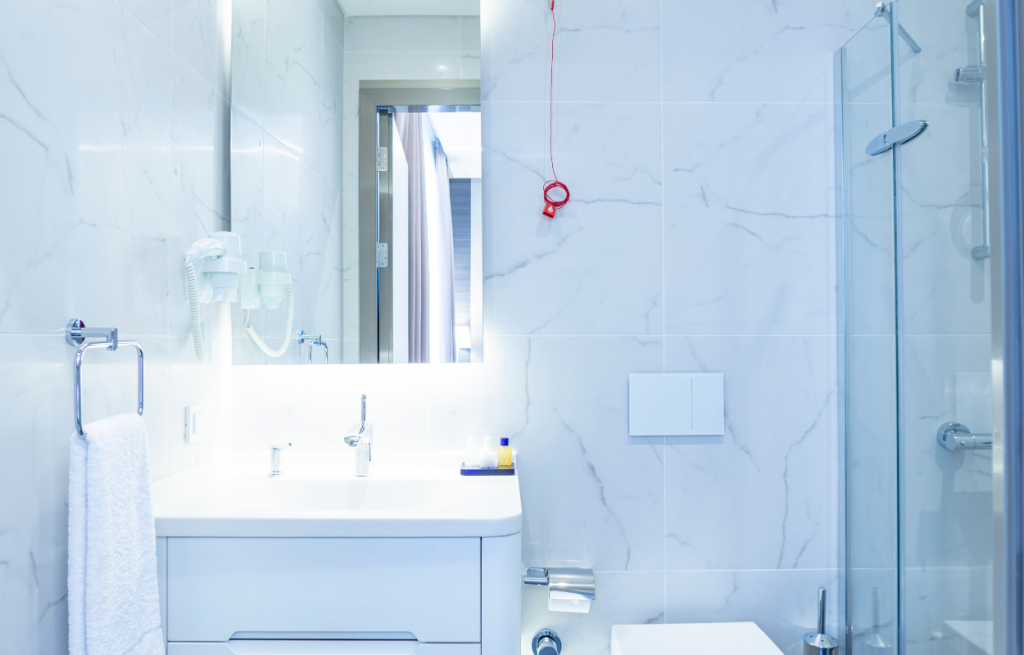
A universally adopted solution is a cable or chain activation mechanism, properly signposted, in order to maximize accessibility. The reason is that this type of activation is the most suitable for use in any situation.
For example, a person with a disability who has fallen to the floor or has become immobilized would not be able to activate a switch located on a wall.
Specifically, regulations recommend that the activation device consist of a red pull cord, with two handles 50 millimeters in diameter. The first handle should be positioned at a height between 800 and 1,100 millimeters, and the second at floor level (100 millimeters high).
Alert elements
To ensure that the signal is perceptible, the most appropriate option is a combination of audible and visual signals. That is, at the control point there should be an audible emitter and a visual indicator, so that both signals are activated simultaneously.
However, current regulations do not require the combination of audible and visual signals in all cases, and the ambient noise level of the area where the control point is located must be taken into account.
Depending on that level, audible indicators of a certain power will be installed. If the sound pressure level exceeds certain limits, the audible signal must then be supplemented with a visual indicator.
Likewise, the characteristics of visual signals will vary according to the features of the space where the alert reception point is located. They must not cause glare, and both brightness and contrast must be adapted to the lighting system of the space, its design, and the placement and dimensions of the furniture.
The control system
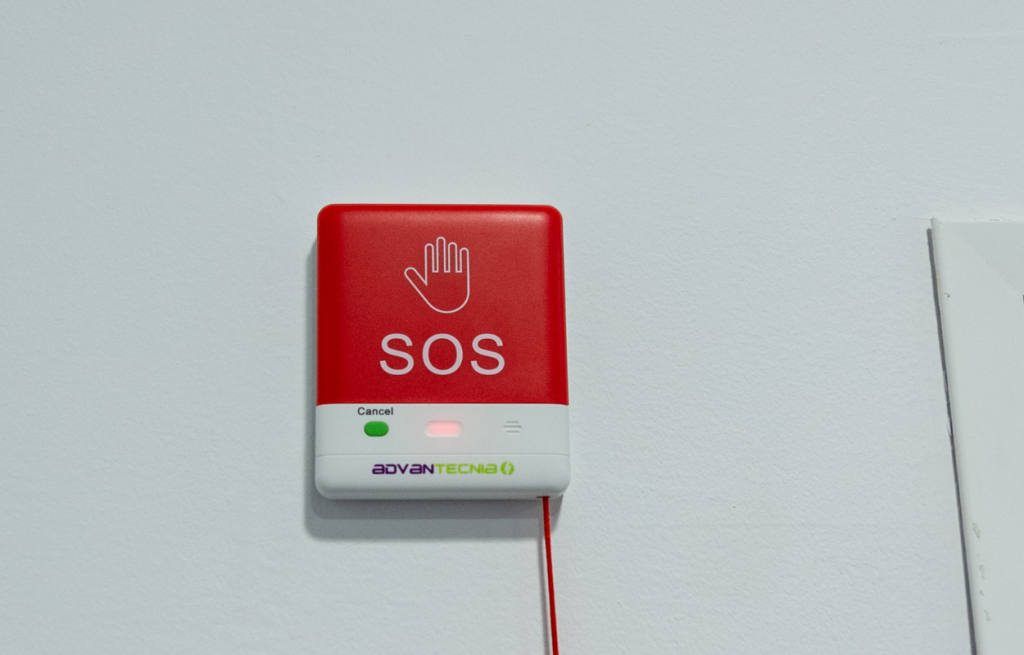
When we talk about a control system, we are referring to the set of electronic devices and software that make it possible for the entire assistive system to deliver optimal operation and performance.
Although activation mechanisms and alert elements are essential, they will be of little use if they are not efficiently managed by the control system.
This is especially important in hospital areas where there is a large number of accessible bathrooms and where it is necessary to simultaneously monitor several people with functional disabilities.
In addition, an optimal control system should be easy to integrate and offer the possibility of being expanded or modified, depending on the needs of the healthcare facility.
Advantecnia: integrated and combinable assistive solutions for hospital bathrooms
Advantecnia offers the most innovative accessible bathroom call systems, designed to address the assistive care and accessibility needs of older adults and users with special needs.
Advantecnia systems are fully integrable in the bathrooms and accessible restroom facilities of hospital environments.
AdvantSOS, a modular, scalable, and integrable assistive solution
AdvantSOS is a state-of-the-art modular solution, fully integrable and scalable.
The system is made up of a set of software andhardware components that facilitate alarm management and communication between the user, their caregiver, and the control elements installed in accessible bathrooms.
AdvantSOS can be adapted to standardized mechanisms or those of other brands, while also complying with the requirements set out in the CTE SUA/3 safety regulation.
In addition:
-
System management can be centralized, organized by zones, or operate in stand-alone mode.
-
Power supply can come from an external source or from a PoE system.
-
Alerts and notifications are communicated via control center alerts, SMS, and email.
Do you need to install an accessible bathroom call system that is innovative, modular, and integrable?
Do you need technical advice on this matter? In that case, contact the Advantecnia team. Our technicians will carefully analyze each of your facility’s specific needs and will propose, with no obligation, the most suitable solutions.