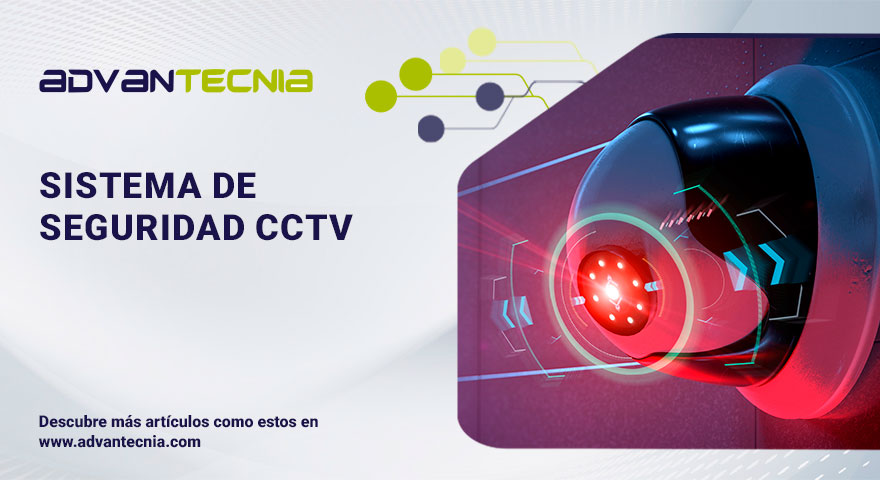
With a good CCTV security system, companies increase their level of protection and security by being able to monitor and record everything that happens in key zones and areas of their facilities, such as entrances and exits, warehouses, offices, parking areas, etc.
Closed-circuit television systems are very interesting due to all the advantages they provide, especially when we talk about sectors where sensitive data and valuable or restricted products are handled (such as healthcare environments, industrial plants, etc.).
At Advantecnia, we are specialists in hospital security and communication, and we help you implement a modern and secure system to control everything that happens in your business, ensuring maximum safety for patients and staff.
Contenidos
What is a CCTV security system and how does it work?
A closed-circuit television system, or CCTV, is a control and surveillance system that uses cameras to capture images and videos in real time, sending them to a central system responsible for recording and monitoring them.
CCTV systems integrate surveillance cameras connected to a recording and monitoring system, which capture images of specific areas and transmit them to a recording device, such as a DVR (digital video recorder) or an NVR (network video recorder). These types of devices store the images for later review and analysis by the security team or by company management or executives.
CCTV systems usually use monitors that display images in real time, allowing active surveillance by specialized personnel. In addition, more modern and efficient systems integrate other advanced technologies such as motion detection, night vision, and remote access via the internet, allowing users to monitor cameras from anywhere through mobile devices or computers.
Objectives of a CCTV system
This type of video surveillance system is used to achieve goals such as:
- Controlling access to restricted areas.
- Increasing the security of people and material resources.
- Having evidence of possible criminal acts (such as theft, robbery, assaults, etc.).
- Preventing potential crimes by acting as a deterrent.
- Improving workplace safety.
- Preventing possible fraud, scams, and other related crimes.
Benefits of using a CCTV system for hospital security
CCTV systems are commonly used in hospital environments due to their great versatility and all the advantages they provide in relation to the security of people and assets.
Let’s take a look at the main benefits of implementing this video surveillance and control technology in companies within the healthcare sector.
24/7 monitoring
These are systems that allow constant monitoring and recording, meaning they operate 24 hours a day, seven days a week. In this way, any incident or problem that occurs can be recorded for later viewing and analysis, even if it happens at night or during low-traffic hours.
In addition, by having batteries and autonomous power supply systems, their operation is guaranteed in all cases, even when there is no general electrical supply.
Indoor and outdoor surveillance
With a closed-circuit television system, it is possible to monitor the interior of the hospital, where important and restricted areas are located, as well as locations outside the facility, such as access areas, parking lots, gardens, etc.
They offer a complete surveillance system that adapts to the specific needs of each healthcare center, regardless of its size or structure.
Flexibility and scalability
A hospital’s needs in terms of control and video surveillance change over time, as new changes constantly occur in this environment, new areas are implemented, and new technologies are adopted.
CCTV systems are scalable, meaning new cameras can be added to the network to monitor different locations or new areas whenever necessary, all without the process being complex or requiring a large financial investment.
Access to new technologies
Although many people often associate CCTV with outdated video surveillance systems, the reality is that these are environments that have evolved and allow the integration of different technologies such as:
- Night vision. Cameras capable of capturing images and video in low-light or nighttime conditions (infrared cameras, for example).
- Motion detection. To record or display areas only when movement is detected.
- Public address systems. Some systems include the ability to communicate directly through a speaker and microphone installed in the cameras, giving the system greater value and versatility.
- High-definition resolution. Providing high-quality images and videos that allow even the smallest details to be seen.
- Cloud storage systems. To store images and videos in the cloud and access them at any time and from anywhere.
What equipment makes up a CCTV system?
Let’s look at the main components used in a closed-circuit television system:
- Surveillance cameras. Responsible for capturing images and videos of a specific area (multiple cameras are usually used, located in strategic areas).
- Screens and monitors. These allow real-time visualization of the areas monitored by the cameras and are used by security personnel to control everything that happens.
- Recording systems. Responsible for storing images and videos on suitable media for later viewing and analysis.
- Power supply equipment. To ensure that the system is always operational, even in the event of a power outage.
- Other technologies. These provide greater efficiency and usefulness to the surveillance system (such as night vision to record at night or in low-light conditions).
We have talked to you about the CCTV security system and its great usefulness in hospital environments, as it is an excellent option for controlling everything that happens in different areas of your facilities. Get in touch with us and we will find the best solution to implement these systems in your business, maximizing the safety of patients, staff, and visitors.