Modern medicine is constantly undergoing a process of continuous improvement to ensure solutions that balance patient well-being with the effectiveness of doctors in performing their duties. The topic we are going to address in this article is hospital bed head units.
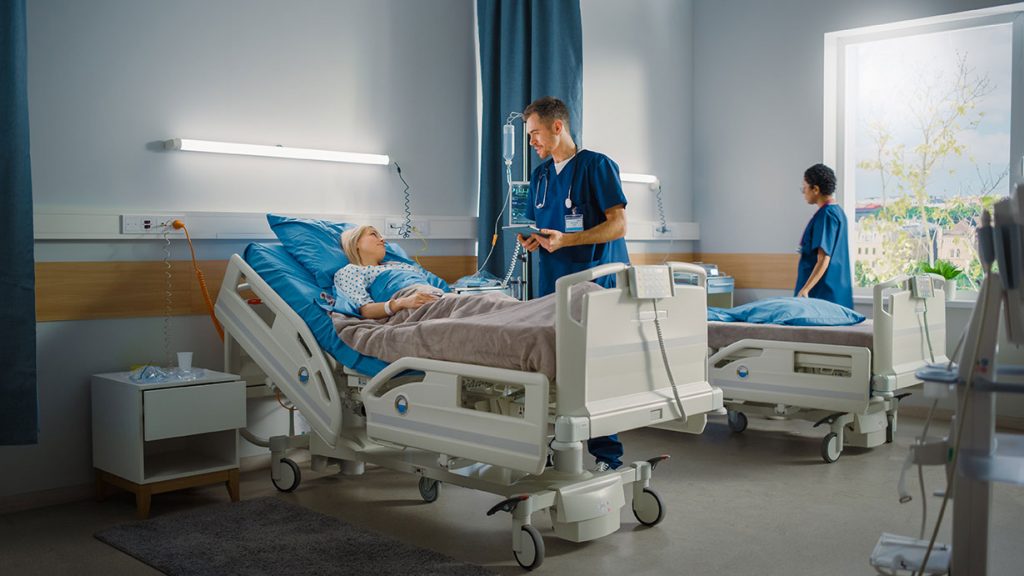
Proof of this ongoing development can be seen in hospital beds, which differ depending on the type of patient who will use them and the medical specialty or ward to which the patient is assigned. A bed in a pediatric ward is not the same as one in a traumatology unit, to give two very different examples.
The same can be said of hospital bed head units, which are not the equivalent of a bed’s headboard. Since they are not part of the bed, what exactly are hospital bed head units?
Contenidos
What is a hospital bed head unit and what is it used for?
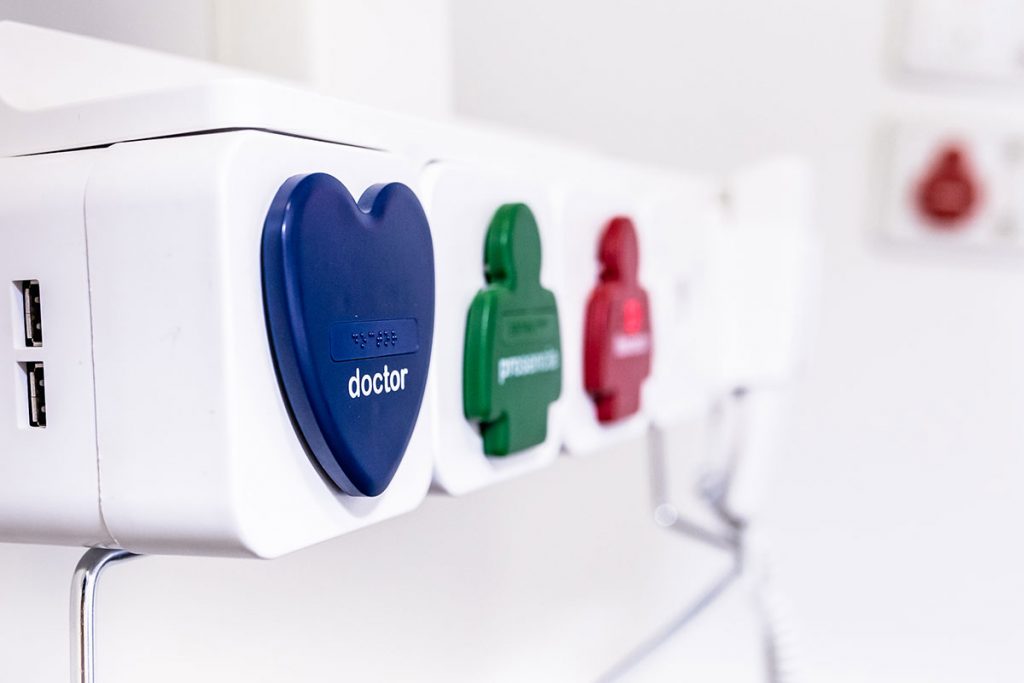
A hospital bed head unit is not the same as a hospital bed headboard. When we talk about hospital head units, we are referring to those structures—arranged horizontally or vertically—attached to the wall and located above the head of the bed or near one of its sides.
These are the devices that patients use to alert the nursing staff if there is a problem, and they also provide indirect lighting for when someone needs to enter or leave the room.
They are structures with numerous outlets designed to perform different functions: gas outlets, electrical sockets, and data ports, all of which must be available in case they are needed.
The most sophisticated hospital bed head units are usually those used in intensive care units and resuscitation rooms, although it would be unusual to see a hospital bed without a corresponding head unit nearby, whether individual or shared.
A true IT system
It might seem that a hospital bed head unit consists of a series of connectors for using electrical and diagnostic devices, some lighting, sometimes a voice recognizer, and an outlet for oxygen-enriched gas. Nothing could be further from the truth.
Inside that box—which appears to be recessed into or attached to the wall and is sometimes decorated to make the patient’s stay more pleasant—a complex system is integrated, one that undergoes constant reviews and improvements.
What is truly complex, the real technological challenge, is providing equipment that can be used by patients in very different conditions, generally quite serious ones. Some patients are able to alert a nurse by pressing a button or raising a hand until an infrared sensor detects it, but many others are not able to do so: intubated or sedated patients, amputees, or patients who must remain completely immobile.
However, all of them require immediate attention in case of need and deserve the peace of mind that comes from knowing that someone just a few meters away will appear within seconds in an emergency. This is where the patient–nurse call system comes into play.

Installed within the hospital bed head unit, it is common to be able to choose between different procedures depending on the type of patient. A knob with a push button is a good solution for a large proportion of patients, and in the case of those with greater limitations, for patients under continuous monitoring—either by healthcare staff or with the assistance of a caregiver.
However, it is also necessary to offer other solutions such as voice activation. These more sophisticated systems, due to the need to distinguish voices and normal background noise from a real call, may or may not be combined with the more traditional nurse call system. The hospital or clinic decides, depending on its budget and the number of beds, how many basic or advanced hospital bed head units will be needed throughout the facility, always calculating with a safety margin in favor of so-called ADVANCALL systems.
Ultimately, it is always better to have outlets or functions that may not be used than to be unable to properly care for a patient in the event of unforeseen situations such as a medical emergency or a natural disaster. This is what oversizing is about, which in the case of hospital bed head units has nothing to do with the number of outlets or the maximum permitted gas flow rate, but rather with the hardware responsible for the patient–nurse call system.
Hospital bed head units are not part of hospital beds themselves; rather, they are structures installed alongside them to ensure patient comfort and more efficient performance of healthcare staff duties. They allow, for example, avoiding the need to move the bed to a separate room to carry out certain diagnostic tests, by making it possible to bring medical devices to the patient and connect them in situ.
However, the most important function of hospital bed head units is how they ensure patient–nurse communication with any nurse, whether those working on the ward or those in the ICU or a resuscitation room. Therefore, hospital bed head units are much more than just a physical element that is more or less integrated into the room’s design.