The large amount of data we handle nowadays, in the middle of the digital era, turns information into a very important asset for any company. Big data in healthcare, for example, is revolutionizing the sector thanks to all the benefits it provides, allowing much more agile and cost-effective care, ensuring that patients receive higher-quality attention. Here we explain what trends exist in big data in healthcare.
Implementing good communication and information management projects in hospitals and healthcare centers is very important to improve medical care and patient well-being.
Contenidos
What is big data in healthcare systems
Big data applied to healthcare refers to the efficient management of the large amount of data generated from different sources and electronic records in companies within the sector. Big data provides a system to capture, store, organize, analyze, and distribute all this information intelligently, in order to extract useful knowledge from the data.
Big data integrates with other technologies such as artificial intelligence (for intelligent data analysis), the Internet of Things (information provided by IoT medical devices), and virtual and augmented reality (to improve research and remote interventions).
What are the benefits of big data in the healthcare sector
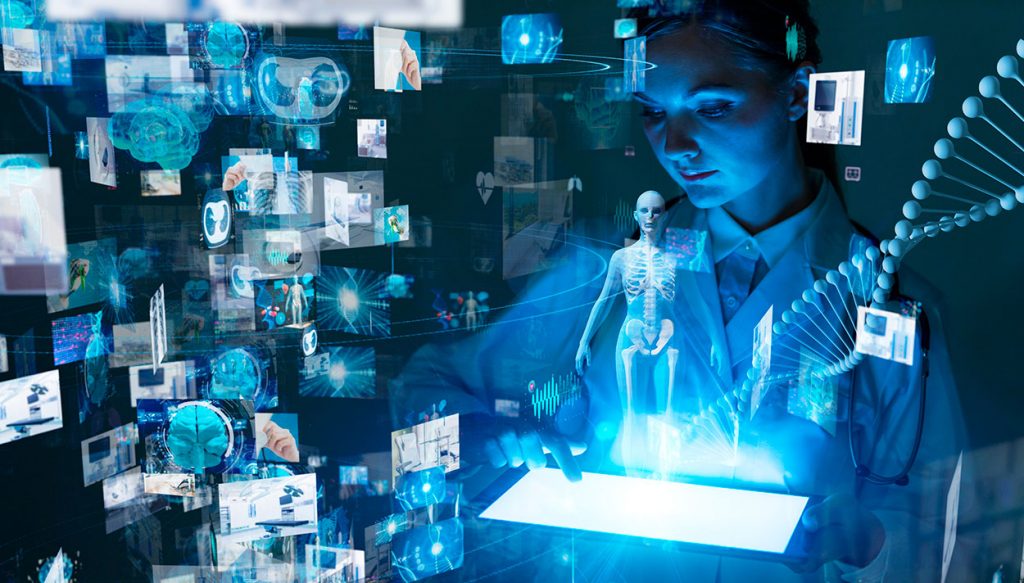
More and more medical and hospital centers are investing in big data, helping to improve access to their healthcare data so that all this information can drive research, diagnostics, drug development, and more. Let’s look at the main advantages of implementing big data in healthcare systems.
Improving diagnoses
With fast and accurate analytics of the large volume of medical information available today, healthcare professionals can make better decisions when diagnosing their patients.
Thanks to the application of big data, diagnoses are faster and more precise, allowing the appropriate treatment to be applied more efficiently.
Disease prevention
Big data makes it possible to identify patterns and trends which, when applied to geographic areas or population groups, facilitate the identification of disease risks, viruses, and other harmful situations for health.
Thanks to the analysis of clinical histories, genetics, and habits, personalized campaigns can be implemented to prevent diseases, infections, and other risk situations.
Development of new medications
COVID vaccines are a clear example of the great advantage of intelligently processing large volumes of data. Thanks to big data, the development of medicines has been significantly shortened, in addition to increasing their level of efficiency.
Cost reduction
The economic factor is fundamental for companies in the healthcare sector, where expenses and investments are really high (equipment, staff, technology, services…). Big data is the key to sector efficiency, helping to reduce time, identify more efficient processes, and make optimal use of available resources.

Keys of big data in healthcare
The success of applying massive data analysis in healthcare is due to a series of fundamental aspects, among which we can highlight:
-
Anticipating the needs of patients and healthcare professionals in order to offer them appropriate services, devices, and tools.
-
Strengthening predictive analysis to be able to act in advance and achieve better results.
-
Personalizing patient care to ensure a much more comfortable experience.
Top trends in digital health
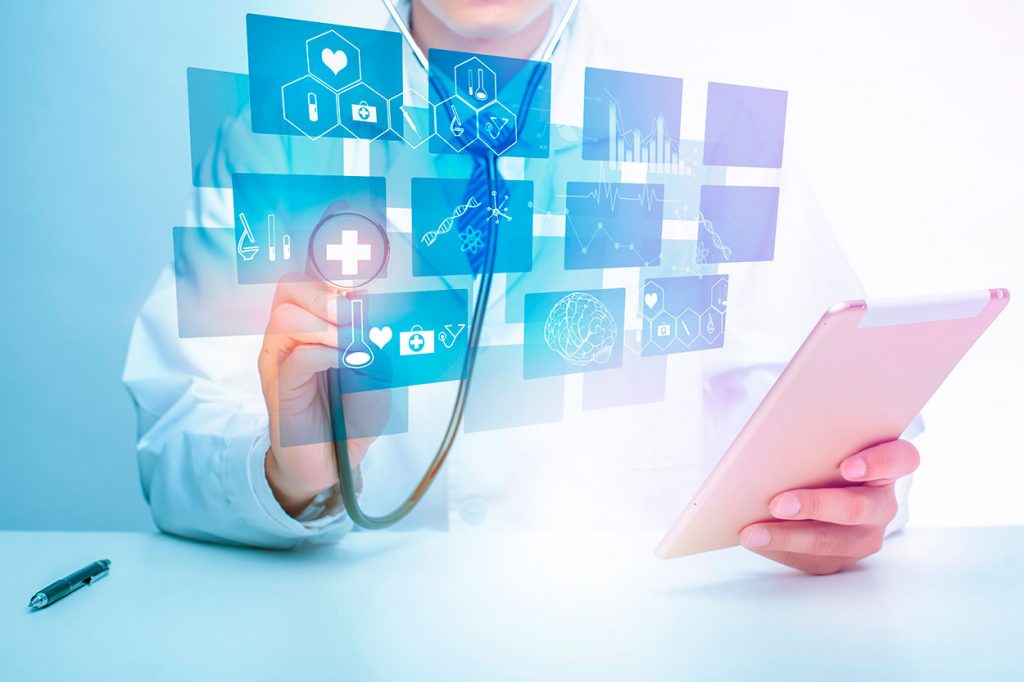
Technology has a major impact on digital health, as it influences very important aspects such as patient care, research and development, cost control, and, in general, improving people’s quality of life. The main technological trends in the healthcare sector are:
Virtual reality
Virtual reality and augmented reality are new technologies that have advanced significantly over the last decade. Today, they are used in the healthcare sector in different areas, such as training doctors and nurses, research and development of new medicines and medical equipment, and even in surgical procedures.
With this technology, professionals and patients can handle virtual objects, perform various tasks, or interact with other people in a virtual environment (ideal for remote medical care, for example).
Artificial Intelligence
Artificial intelligence uses sophisticated mathematical algorithms to enable a machine, computer, or device to behave in a way similar to humans. In healthcare, AI helps improve the analysis of health data and medical images (X-rays, MRIs, ultrasounds, etc.), allowing reports to be generated in less time and with a higher level of accuracy.
Self-monitoring solutions
Wearables are self-monitoring solutions that patients can use in their daily lives to track vital signs and other important health parameters.
These devices help people better manage their health and make more informed decisions when a parameter is detected outside ideal values (for example, measuring blood sugar levels in diabetic patients).
Robotics
Robotics is one of the technologies having the greatest impact on the healthcare sector. Both in drug development (speeding up processes and avoiding risks and errors) and in complex surgeries, robotics has already become an essential part of healthcare.
In addition, robots are beginning to perform other important tasks such as disinfection and cleaning, support in patient care, and reducing the exposure of healthcare professionals to viruses, bacteria, etc.
The future of big data in healthcare is promising, as it is a technology that enables major improvements at different levels. The large amount of information handled in the healthcare sector makes big data an ideal solution to improve patient care and diagnostics, as well as to achieve other benefits related to cost reduction and drug development.
At Advantecnia, we offer you a variety of solutions to improve hospital systems. You can contact us to request more information about our products and services.