Although intelligent hospitals may seem like something from the future, the truth is that they are already a reality. Thanks to technology, patient care becomes much more efficient, making the work of healthcare professionals simpler and promoting a faster recovery for those suffering from illness or injury.
The implementation of technology in hospitals and healthcare centers may seem like science fiction, but in practice, it is simpler than it seems.

Contenidos
Digital hospital care
The smart hospitals that are already operational are making the most of the latest digital technologies to improve care and minimize risks.
A good example is telemedicine. Through something as simple and common today as a video call, the healthcare professional can conduct an initial assessment of the patient and determine if it’s necessary to see them in person for a diagnosis.
This system also allows monitoring of patients with chronic illnesses and those who have been discharged from the hospital, with no need for them to travel to the primary care center or hospital.
Another example of technology applied to the field of medicine is smart pills. These small pills that the patient swallows allow them to obtain images of their digestive system. It is undoubtedly a much less invasive alternative to gastroscopy or colonoscopy.
Undoubtedly, a great revolution in smart hospitals is the tele-surgery robots, which allow high-precision surgical interventions. Additionally, these devices can be controlled by doctors who are not physically present in the same hospital as the patient.
The result of all this technology is much more efficient and personalized care for the users of healthcare services.
Scenario Example
The best way to understand how smart hospitals work is with an example:
María is a 70-year-old woman with a severe case of osteoporosis, and her specialist has decided that the best option is to place a hip prosthesis to relieve her pain.
On the day scheduled for the intervention, María goes to the reception desk, where she is assigned an intelligent bracelet. This bracelet automatically monitors her vital signs and even provides information on how to reach her room.
Before the surgery, she is given a 3D-printed hip prosthesis that is biocompatible and durable.
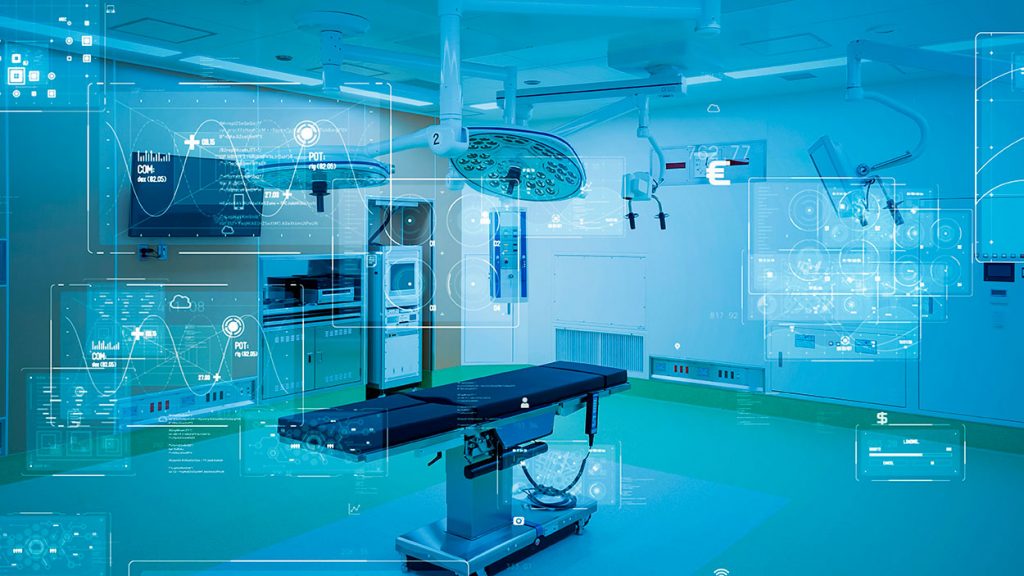
When María arrives at the operating table, she sees a large surgical robot that will be responsible for carrying the weight of her surgery. It will be operated by the prestigious Dr. Olot, one of Spain’s leading experts in hip prosthetics, who is not in the same hospital as the patient but in another autonomous community. With the help of the robot, using 5G technology and Augmented Reality, the surgeon will perform the operation remotely.
Once the surgery is completed, the patient will be placed on a bed with a complete monitoring system, and she will also be able to contact the nurse, so she won’t need a family member to take care of her 24 hours a day in the hospital.
After going home to continue her recovery, María will have a consultation with her specialist via videoconference. To ensure nothing goes wrong, the specialists can use medical apps to receive real-time updates on the patient’s condition.
Advantages of smart hospitals
Technology is becoming the best ally possible for healthcare professionals, as it allows them to provide more personalized care to each patient.
Constant monitoring of variables through new technologies such as smart wristbands helps improve the quality of care. Without the need to go to the room, healthcare personnel can know if the patient has a fever or if their blood pressure has increased.
All this information is directly uploaded to the patient’s medical record, so there is a record of how the patient’s condition is progressing.
The result is that communication between healthcare professionals and patients improves, as the specialist can know if something is wrong even before speaking to the patient. At the same time, human error is reduced, and associated costs are saved.
What is achieved is, ultimately, improving the patient experience through quality care and greater operational efficiency.

Implementation
The path to smart hospitals has just begun. At the moment, the focus is on the optimization and automation of processes through the Internet of Things. The goal is to achieve the connection of different devices that help monitor and control healthcare variables, and ensure that all this information is collected in the cloud.
According to the data from the study Future of Smart Hospitals, by 2025, 10% of hospitals worldwide will be immersed in this digital transformation. According to this report, there are four major work areas to improve hospital efficiency and quality:
-
Automation of pharmaceutical services.
-
Tracking assets for better resource management.
-
Data analysis for decision-making.
-
Cloud computing to manage information and ensure its security.
The implementation of technology also presents a series of challenges. Among the most important is the interoperability of different systems, areas, and healthcare phases to achieve good coordination, and cybersecurity for sensitive data.
Smart hospitals represent a big challenge, but they will make a significant difference in the quality of medical care. If you want to implement technology in your facility, get in contact with us to learn more about our solutions.