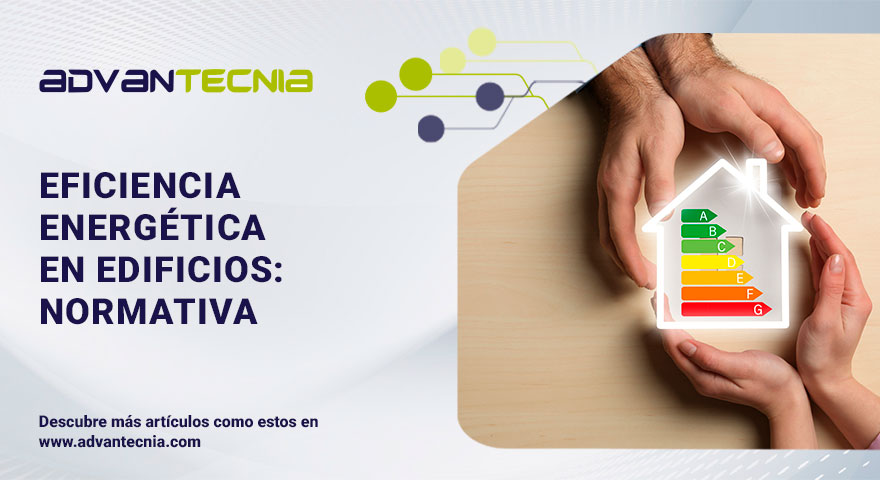
The concern for creating sustainable buildings and improving existing ones is a reality across all levels of our society: the political sector, as well as citizens and companies, are making efforts to achieve the objectives set by the European agency in this regard. Energy efficiency in buildings is governed by regulations that have recently changed. In this context, we work with companies that understand that change is supported by the major options offered by technology. An example of this is what we do at Advantecnia, which is why we offer our services to senior centers, hospitals, and nursing homes that need to adapt to the energy certification regulations in our field.

Contenidos
Main updates to the energy certification regulations
We need to look back to 2021 to find the latest Spanish regulations governing everything related to energy certification. Specifically, we are referring to Royal Decree 390/2021 of June 1st.
In this text published in the Official State Gazette, very specific information was provided about the basic procedure for buildings to obtain energy efficiency certification. It also repealed the previous regulation, governed by RD 235/2013, of April 5th of that year.
The modifications made two years ago were related to:
- A new procedure to assess whether or not the minimum conditions for building energy certification are met.
- Different values when carrying out measurements, adapted to current times and needs.
- Real estate companies must display the energy efficiency certificate of properties for sale or rent so that interested clients can consult it.
In addition, among the main new features of this regulation is a greater number of buildings that are now required to have an efficiency certificate, methods to renew and update previously obtained certificates, and other types of procedures that must be taken into account both in the private sector and in public spaces such as schools, hospitals, or residential facilities.
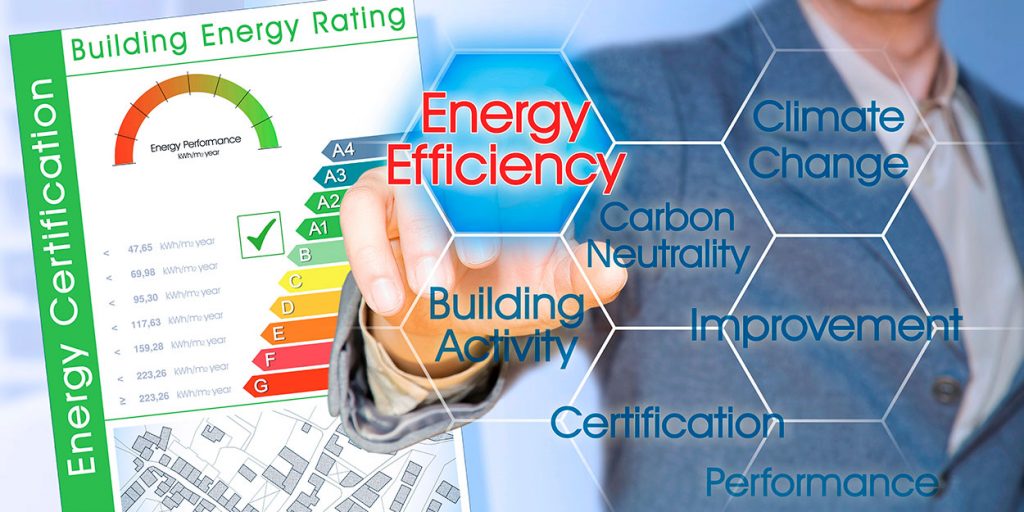
Buildings required to have an energy efficiency certificate
Newly constructed buildings were already regulated by previous Royal Decrees. Obviously, any construction project that starts nowadays must already include planned measures such as reduced electricity consumption, high insulation, and other features that lower the ecological footprint and residents’ energy costs.
This obligation also includes existing buildings or homes when they are going to be put up for sale or rent. In this sense, the objective is for the buyer or tenant to be aware of the level of energy consumption of their new home, in order to decide whether it is worthwhile to purchase it or sign the lease agreement.
From 2021 onwards, the regulation includes the following scenarios:
- Buildings or parts of buildings used by the Public Administration larger than 250 square meters.
- Buildings undergoing modifications or extensions, such as: renovation of thermal installations, interventions affecting more than 25% of the total thermal envelope surface, or an increase in the final surface area by more than 20%.
On the other hand, buildings larger than 500 square meters with administrative, healthcare, commercial, educational, cultural or residential uses, among others, must also obtain this energy efficiency certificate.
Finally, any construction that must undergo a Technical Building Inspection will be required to submit the certificate to the administration for the study of the property’s energy consumption.
Validity, renewal, and updating of the energy efficiency certificate
One of the most frequently asked questions, both by individuals and companies, is how long the certificate is valid, when it needs to be renewed, and whether it must now be updated in accordance with the new Royal Decree.
As things currently stand, a favorable energy certificate — higher than category G — has a validity of ten years.
In the case of buildings or properties with a lower rating, a new in-person assessment of the home or building must be carried out within a period of no more than 5 years.
Even so, each autonomous community in the country may establish different procedures or formulas for renewing and updating the certificate, within the general guidelines set at the national level.
There may also be situations in which a property or an educational building, residence, or hospital has undergone an improvement process. In these cases, those responsible may request a voluntary update, as it will be much more favorable and will improve the value of the property, as well as the image that companies project to their clients.

Obligation regarding the energy efficiency certificate
Article 17 of RD 390/2021 of June 1 establishes that all the buildings mentioned above must have an energy efficiency certificate on a mandatory basis.
Obviously, new construction projects must apply for it once the work is completed, so that the corresponding assessment can be carried out.
In purchase or rental contracts, the “energy certificate in process” is no longer valid. The new regulation does not accept this possibility as an option, and a notary must always certify that the energy certificate is valid and has been prepared by specialized technical professionals.
This must be taken into account not only by the owner and the final seller, but also by intermediaries: real estate agencies, web catalogs, and the press are required to request the certificate and provide information about it when advertising properties. Failure to do so may result in fines for all parties that do not comply with the Royal Decree.
In this sense, Advantecnia’s systems are not only key in the functions of a nurse in a hospital, but they also contribute to energy efficiency in buildings in accordance with current regulations. Our lighting systems, temperature sensors, and outputs for controlling lights or devices allow centralized control of all these values to reduce costs without negatively affecting patient comfort.