More and more spaces (from hospitals to restaurants) are dedicating part of their public-access bathrooms to people with diverse accessibility needs. For this reason, there are specialized companies in adapting spaces that offer their contact to prepare facilities in accordance with accessible bathroom regulations. The objective is the full integration of all citizens, ensuring that no one feels excluded simply because they need to use a bathroom and cannot access it with a wheelchair.
Spanish legislation has taken very important steps in this regard, and there are increasingly more regulations aimed at the full integration of people with disabilities. One of these is Law 10/2014 of December 3, which establishes which spaces must be adapted immediately and the minimum requirements they must meet. Here we explain how to comply with accessible bathroom regulations.
Contenidos
Who does this regulation affect?
The law governing accessible bathroom regulations clarifies, in Article 21, that public-use buildings are the ones that must provide “accessible toilets in public-use areas.” In addition, whenever possible, it will not be sufficient to install a single toilet with these characteristics; instead, there must be a specific space for men and another for women.
Current legislation affects all developers and builders who undertake a construction project, provided it meets the characteristics set out in the Law and in the decrees and regulations that complement it. In this sense, it is essential to be thoroughly familiar with this documentation to ensure whether it is necessary to design an accessible bathroom in any project that is going to be carried out.
The remaining specifications appear in other legal publications, such as Royal Decree 173/2010, which already includes precise instructions on the layout and characteristics of spaces, or in the Basic Document on Safety of Use and Accessibility, an official text that must also be followed when designing an accessible bathroom.
What is an accessible bathroom like?
The goal of an accessible bathroom is to ensure that people with physical disabilities can, if they wish, use the bathroom independently in a comfortable and safe way. For this reason, all the facilities within the same room must be adapted for wheelchair users, which means taking many aspects into account.
Access
The entrance door to the bathroom must be wide enough for a person in a wheelchair to enter without difficulty. In addition, the door should open outward or be sliding, leaving the entire interior space unobstructed, and if there is a change in level, access must be facilitated with a ramp.
It is also important that the bathroom has an appropriate locking system so it can be used without fear of someone entering unexpectedly.
Interior dimensions
Taking into account that the door will open outward or be sliding, inside the bathroom it must be possible to draw a 1.50-meter diameter circle completely free of obstacles. Only in this way can it be ensured that a person in a wheelchair can operate comfortably and move toward the toilet, sink, etc.
Sink
When talking about the sink, it must be installed inside the bathroom cubicle whenever space conditions allow. In addition, it is recommended that it be a wall-mounted or frame-mounted sink, so the height can be adjusted to the user’s needs.
Another relevant point in this regard is that there must be no furniture or elements that prevent the person from getting close enough to wash themselves properly.
Mirror
Tiltable up to 10 degrees at the user’s request, mirrors must have a minimum size of 46 × 137 centimeters. Regarding placement, it is very important that both seated and standing users can see themselves clearly reflected.
Toilet
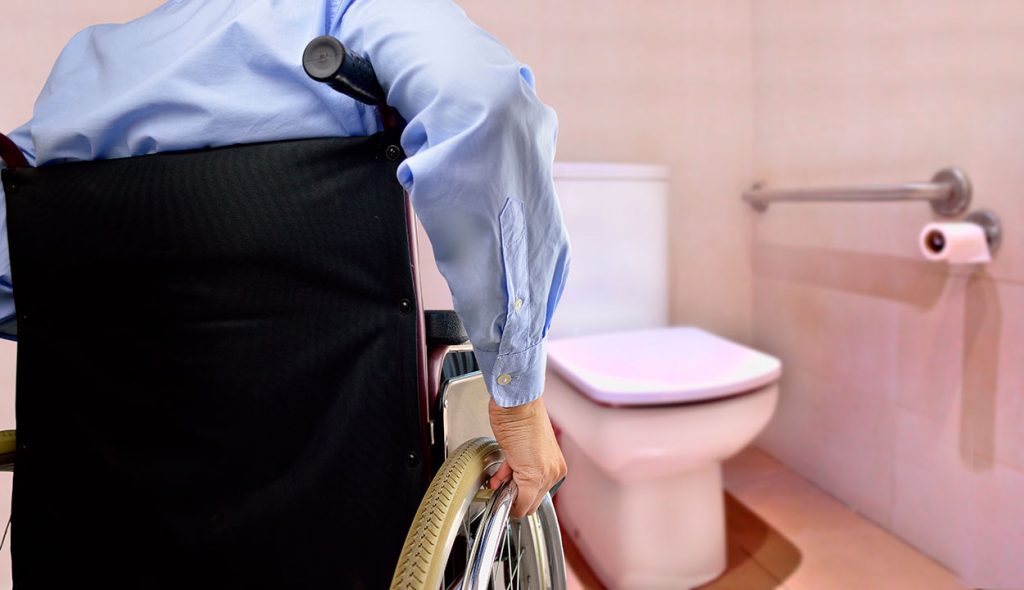
Adapted toilets must be installed at a height not exceeding 47 centimeters. This is designed to ensure that transferring from a wheelchair to the toilet is comfortable and safe.
In addition, the area where it is installed must have sufficient space so that a person using a wheelchair can position it next to the toilet to make the transfer. This lateral space must be at least 75 centimeters.
Cistern
The only requirement indicated by regulations for the cistern is that it must be easy to operate for people with mobility impairments in the upper limbs. The usual solution is the installation of a lever or a large-format push button, positioned in an easily accessible area.
Grab bars
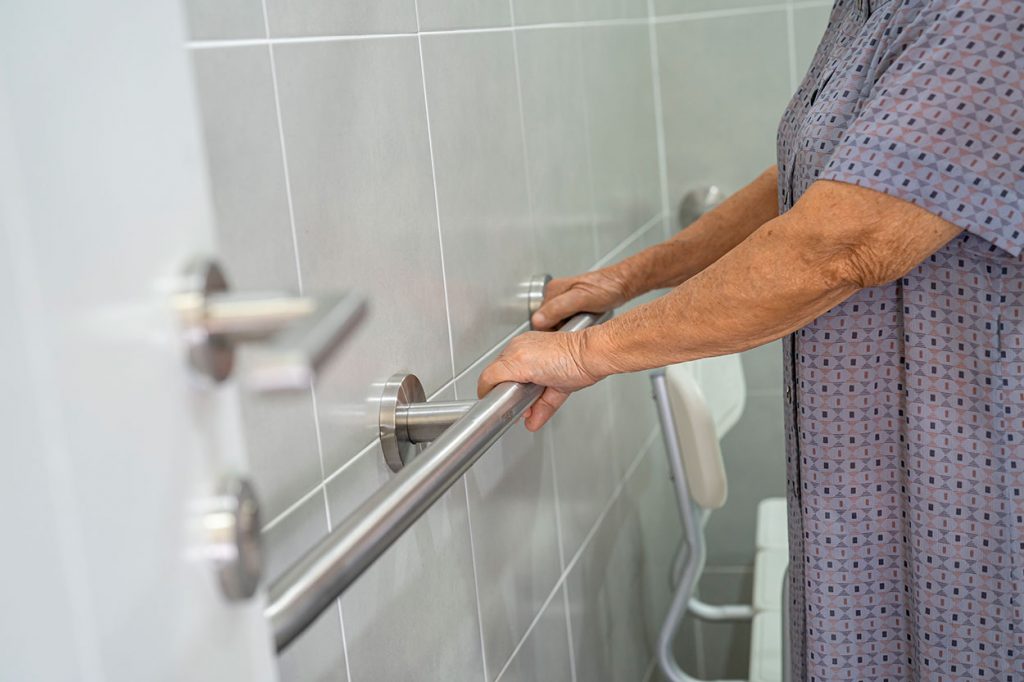
Grab bars are essential for proper use of the bathroom by people in wheelchairs or using crutches. Accessible bathrooms must have a two-bar structure surrounding the toilet (one on the right and one on the left), allowing the user to support themselves easily when sitting down.
For greater comfort, it is recommended that the bars be foldable. In addition, they must be installed 35 cm from the toilet’s centerline and no higher than 75 centimeters from the floor.
Shower
It is not always possible to have an accessible bathroom with a shower, but in spaces such as residential homes, healthcare centers, etc., it is more common for both showers and bathtubs to be available.
In the case of the shower, the tray must be level with the floor and have dimensions of 135 × 135 cm if it is used independently. It is important that it is made with non-slip flooring and without any type of slope.
A slope should only exist in the drainage area, and it must not exceed a 2% incline.
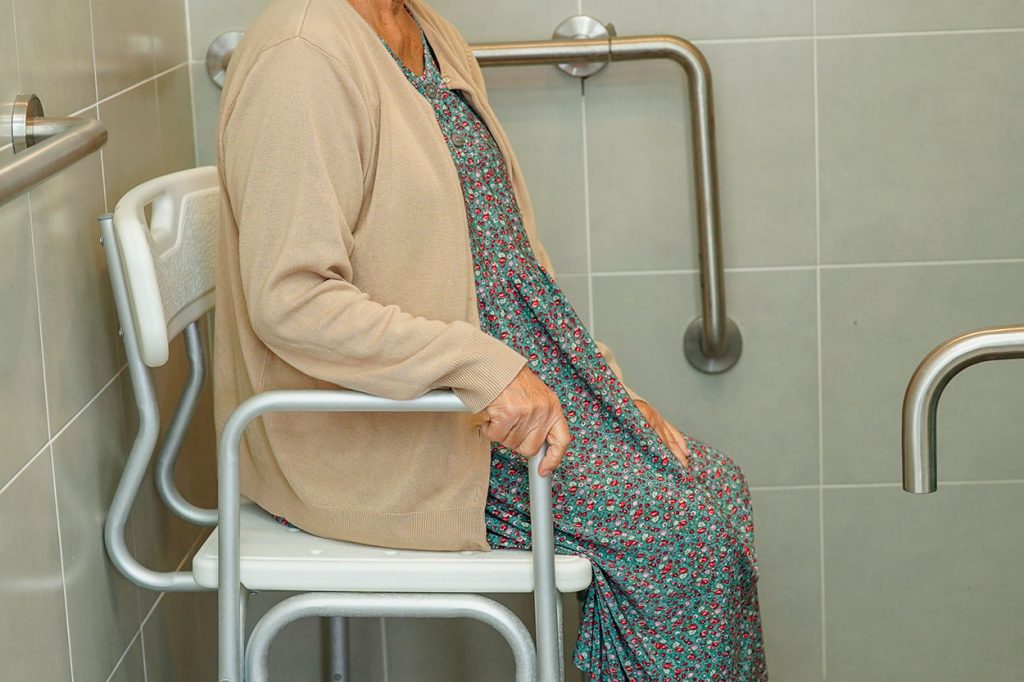
Finally, it is necessary to refer to the faucets, which must be installed at a comfortable height so they can be operated while seated. The seat must be foldable and sufficiently comfortable and wide to allow the user to wash their back without increasing the risk of falls.
It is common to install a nurse call button in residential homes or care centers so that users can request assistance if they consider it necessary.
Bathtub
Regarding bathrooms with bathtubs, the fixture must be adapted with frontal or lateral access, and it will be necessary to install a hoist or a transfer seat to allow access into the space.
The edges must not exceed 45 centimeters, and the bottom must be non-slip to improve comfort for people who choose to bathe in them. Nowadays, there are even height-adjustable models to assist care staff when bathing people with mobility difficulties.
All these requirements are designed to ensure greater user independence and to ensure that the use of the bathroom is dignified, safe, and comfortable. Following each of these steps defined by accessible bathroom regulations is the best way to create suitable spaces for people in these circumstances. Contact us if you need more information on this matter.